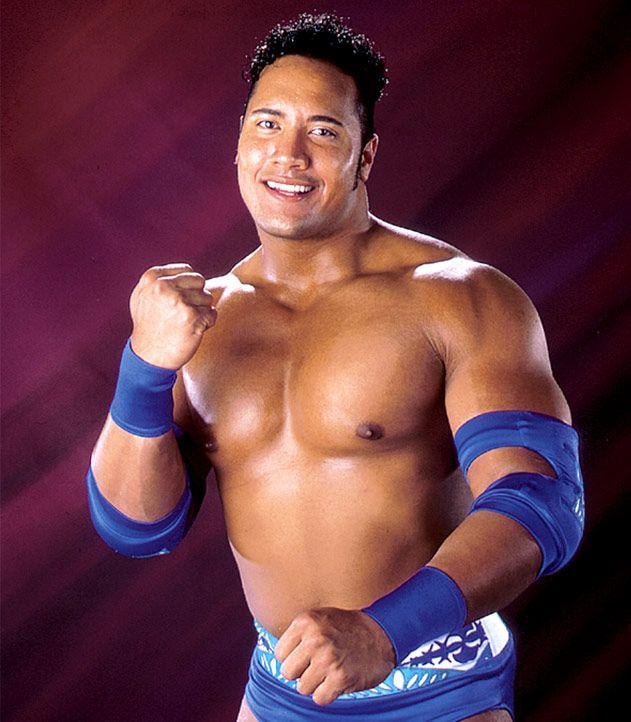
November 4, 1996 — WWF Monday Night Raw, Fort Wayne, Indiana. Before he was the Most Electrifying Man in Sports Entertainment, before the catchphrases and the raised eyebrow, he was a smiling rookie in bright blue trunks with a name borrowed from his father and grandfather. On this night, the future Rock walked onto WWF television for the very first time — and almost nobody realized what they were watching.
The Setup
Dwayne Johnson came to wrestling with a pedigree nobody else could claim. His father was Rocky Johnson, a former WWF Tag Team Champion. His grandfather was “High Chief” Peter Maivia, a Samoan wrestling legend. Put those two names together and you get the name Vince McMahon gave the 24-year-old rookie: Rocky Maivia — billed as the first third-generation superstar in WWF history.
The WWF did not ease him in quietly. The company hyped him as “The Blue Chipper,” the clean-cut, can’t-miss prospect, a smiling babyface built for the top of the card. His football career at the University of Miami hadn’t led to the NFL, so wrestling — the family business — was the plan. And the plan, from day one, was a big push.
The Debut
The November 4 episode of Raw was taped October 21 at the War Memorial Coliseum in Fort Wayne, Indiana, and it opened with a match that doubled as a Survivor Series preview: Goldust against The Stalker, with both men’s Survivor Series teams at ringside. The match ended in a double disqualification, and the post-match melee spilled everywhere — and right into the middle of it ran Rocky Maivia, backing up his teammate The Stalker.
That was it. No match, no promo, no catchphrase. Just a rookie running in to even the odds, introduced to the television audience as the newest member of the Stalker-led Survivor Series team.
Thirteen days later came the real in-ring debut, and it was anything but small: Survivor Series at Madison Square Garden, November 17, 1996. Maivia teamed with Marc Mero, Jake “The Snake” Roberts, and The Stalker against Crush, Goldust, Triple H, and Jerry Lawler. By the end of the match, Maivia was the sole survivor — pinning Crush, then finishing Goldust with a shoulder breaker to win his first-ever WWF match in front of 22,000 fans at the Garden. Three months later, he beat Triple H for the Intercontinental Championship on Raw.
Why It Still Matters
Here’s the twist that makes this debut story so good: the push worked too well, and then it backfired completely. Fans, handed a squeaky-clean, heavily pushed rookie, turned on him. The “Die, Rocky, Die” chants became one of the loudest rejections of a babyface in the company’s history. And that rejection is what forced the reinvention — the sneer, the arrogance, the third-person promos, the Nation of Domination, and eventually, simply, The Rock.
Every great wrestling reinvention starts with a version that didn’t work. Rocky Maivia — the Blue Chipper, the smiling third-generation kid who ran in during a brawl on a November night in Fort Wayne — is the before picture. The Rock is the after. Without the first, you never get the second.
It says something about that November 4 Raw that the same broadcast also carried one of the most controversial angles of the decade — but that’s a story for another episode. This night belonged to the debut: the first television appearance of the man who would become the biggest star wrestling ever produced.
Sources: Cageside Seats — This Day in Wrestling History (Nov. 4) ; Pro Wrestling Wiki — November 4, 1996 Monday Night RAW results ; The Sportster — Attitude Era: How Rocky Maivia Became The Rock, Explained


Leave a Reply