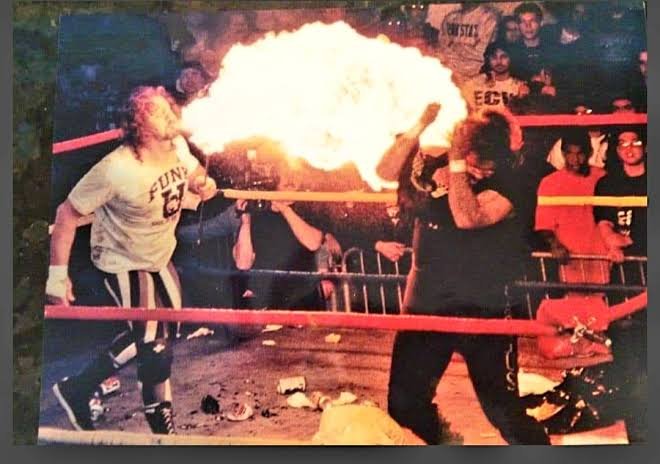
October 28, 1995 — ECW Arena, Philadelphia. A flaming chair, a spot nobody had cleared, and a wrestling legend on fire at ringside. Thirty-one years later, it’s still the night ECW went further than even ECW could defend.
THE SETUP
By the fall of 1995, ECW had built its whole identity on going further than anyone else would dare. The blood feud at the center of the company was Tommy Dreamer and Terry Funk against Raven and Cactus Jack — Mick Foley, playing the cowardly heel trying to talk Dreamer out of the ECW dream and into a comfortable WCW payday.
That night at the ECW Arena, Dreamer beat Cactus Jack with Funk in his corner. Earlier on the same card, Mikey Whipwreck had shocked the building by beating The Sandman for the ECW World Heavyweight Championship. It was already a wild night in South Philly. Then the post-match brawl started, and it stopped being a wrestling show.
Funk came out swinging a flaming branding iron. Raven and Cactus answered with something worse: a steel chair wrapped in towels soaked in lighter fluid, lit from Funk’s own branding iron. It was a spot Funk and Cactus had done in Japan, where a kerosene-soaked rag wrapped around a chair had worked as a weapon. In a packed, low-ceilinged bingo hall, it was a different equation entirely.
THE NIGHT IT WENT WRONG
The first swing found Dreamer, who threw himself in front of Funk and took the burning chair. The second swing is the one people still talk about. As Cactus wound up, the burning towels came loose — fire, as one ringside reporter noted at the time, has a habit of not staying attached to a chair. The flaming towel landed on Funk’s back. His shirt went up. For a few terrifying seconds, one of the greatest wrestlers who ever lived was a man ablaze at ringside, running while fans reached over the barricade trying to put him out.
Then it got worse. Arena staff came out with fire extinguishers and sprayed burning debris across the ringside area and into the crowd. And then — with fans still panicked, coughing, and hurt — ECW killed the house lights for roughly two minutes, exactly as planned, so Raven could set up his “crucifixion” angle with Dreamer up in the crow’s nest. The darkness sent a crowd that already feared the worst stampeding for the doors.
The toll: Funk went to the hospital with second-degree burns on his right arm, from bicep to elbow, and burns on his back. Dreamer suffered burns and a broken nose. Fans were injured in the crush — a broken nose, a reported broken leg, burns — and one fan later sued the company. Backstage, Funk was reportedly furious — throwing chairs, upset about the pain and the work he was about to miss. He had only recently finished months of treatment for burns suffered in Japan; now the process would start all over again.
WHY IT STILL MATTERS
Here’s the question that makes this story more than a gruesome anecdote, and it’s the one ECW fans still argue about: who actually signed off on this?
According to Dave Scherer’s ringside report from that night, the fire spot was devised by Funk and Cactus — and was reportedly not known to Paul Heyman beforehand. Scherer himself added the line that settles the argument and starts it at the same time: the buck stops with Heyman, and it is ultimately his responsibility. Heyman later apologized and promised ECW would never use fire again — a promise that, like so many in wrestling, did not hold.
That tension is the whole story of ECW in miniature. The wrestlers booked their own programs, the promoter trusted his wildest talents, and the line between “extreme” and “out of control” was whatever the last spot had been. On October 28, 1995, the line caught fire — literally — and a legend, his opponent, and the paying customers all paid for it. ECW survived the night. Its reputation as a company that would do anything never quite recovered its innocence, because after this, everyone knew exactly what “anything” could mean.
Sources: Dave Scherer’s ringside report from the night (via PWInsider’s “This Day in History” archive); Mike Johnson’s retrospective as a ringside witness (PWInsider); Paul Heyman’s account in “The Rise and Fall of ECW” (via WhatCulture); Scott E. Williams, Hardcore History: The Extremely Unauthorized Story of ECW.


Leave a Reply